News
IN TROUBLED TIMES, MSO BRINGS AN ODE TO JOY
The Memphis Flyer • Alex Greene
Sunday’s performance of Ludwig van Beethoven’s Symphony No. 9 in D minor, op. 125, the “Ode to Joy,” by the Memphis Symphony Orchestra (MSO), the Memphis Symphony Chorus, and the University of Mississippi Concert Singers, was a deeply emotional experience, in part because it held a mirror up to this moment in history.
For many, it began on the heels of “The Star Spangled Banner,” when the orchestra and chorus launched into another national anthem, “Державний Гімн України,” aka “The Glory and Freedom of Ukraine Has Not Yet Perished,” echoing orchestras and performers around the world who have done the same in recent weeks. The translated lyrics, projected on a screen above the players, gave a clue as to why the fledgling democracy has been giving the Russian Army a run for its money:
Still upon us, young brethren,
Fate shall smile!
Our enemies shall vanish
Like dew in the sun.
But the feelings evoked in the audience were clearly those of sympathy and solidarity more than the ire of the warrior. Breaking the spell somewhat, the orchestra then presented a short bon-bon of a piece, Michael Markowski’s Joyride, full of whimsical quotations of the Beethoven masterpiece that was to follow. To these ears, hearing a somewhat coy preview of some of the grandest motifs in the Western classical canon was a distraction, but perhaps for musicians who have played Beethoven’s Ninth all their lives, it was a welcome palate cleanser.
And then, speaking for a moment, conductor Robert Moody brought our thoughts back to the philosophical, reflective, and historical dimensions, especially when he noted that MSO member Andre Dyachenko was born in Ukraine. (The principal clarinetist simply held his instrument aloft in a nod to the acknowledgement).
And then Moody leaned into this historical moment. “Of course, music cannot stop a tank,” he said, “any more than it can stop a virus.” But, noting that Beethoven began composing his Ninth Symphony in 1822, Moody said that such music persists by appealing to the better side of humanity — a force to be reckoned with. The piece has been performed for 200 years, and will be performed for another 200, he said, precisely because it brings out our best.
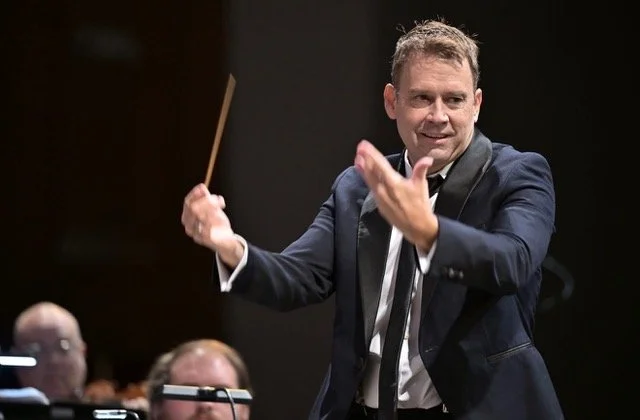
With that, the game was afoot, as the MSO collectively braced themselves and leapt into the percussive themes of the first movement under Moody’s emphatic gestures. And the performance that followed was supremely sensitive to the work’s dynamics, from the timpani’s bombast to every sudden shift to waves of flowing strings. The blending of the tones of the horns, strings and woodwinds was especially adept.
All of it served to remind us of the world class institution Memphis has on its doorstep. And that was amplified further when the vocal soloists, Laquita Mitchell (soprano), Taylor Raven (alto), Limmie Pulliam (tenor), and Joshua Conyers (baritone) came to the front and galvanized the house with the flowing German poetry of lyrics based on Friedrich Schiller‘s writings.
The epiphany of Beethoven’s pioneering work was felt anew, as if the Memphis audience was witnessing its premiere, especially when the combined power of two choral groups stood to deliver their passages with overwhelming passion and precision. The message of hope and transcendence embodied by “Ode to Joy” was made all the more powerful by the translations that appeared once again on the screen.
Joy, bright spark of divinity,
Daughter of Elysium,
Fire-inspired we tread
Within thy sanctuary.
Thy magic power re-unites
All that modernity has ruptured,
All men become brothers,
Under the sway of thy gentle wings.
The somewhat unconventional translation (i.e., replacing the usual “custom” with the term “modernity”) served as an invitation to take the words to heart in these terror-filled times. The fact that “Ode to Joy” has been adopted as the European Union’s anthem linked it with the contrasting lyrics and gravitas of Ukraine’s national anthem, and brought home the current era’s struggles, which hold all who oppose authoritarianism and terrorism captivated. Somehow, as Dr. Donald Trott and Dr. Elizabeth Hearn (directors of the University of Mississippi Concert Singers) and Dr. Lawrence Edwards (director of the Memphis Symphony Chorus) joined Moody and the MSO players in a bow, all of that historical passion was expressed in the long, well-deserved standing ovation.
ROBERT MOODY CHANGES THE TEMPO OF THE MEMPHIS SYMPHONY ORCHESTRA
Memphis Magazine • Anna Traverse
Allegro.
We could begin with a scene of Robert Moody standing before an expectant Memphis Symphony Orchestra: Bows poised above strings, flutes flourished and ready. All eyes on Moody, the conductor and, as of this month, music director of the MSO. All the pieces in place.
Or we could begin with a piece of possum cake. Moody and I have been talking only a few minutes when he mentions the possum cake. He is originally from Greenville, South Carolina, but, he explains, his mother’s family is from a farm community in South Carolina called Possum Kingdom. “I did not make it up,” he says.
Just this spring, to focus exclusively on Memphis, Moody has ended long-term relationships with several orchestras around the country. One of these was the Winston-Salem Symphony, where he became music director in 2005. At his farewell party, Moody was fêted with a life-sized possum-king cake (not to be confused with king cake; to my knowledge, there was no tiny plastic baby possum baked within). “Please tell me you have a photo,” I say. Moody produces his phone to show, sure enough, the sweetest (and, well, only) piece of possum fondant royalty I’ve ever seen: a prickly looking number complete with rakishly askew crown, and slightly unsettling eyes.
It’s an early summer, already sultry morning at Memphis Botanic Garden. The MSO players are assembled on stage for one final rehearsal before playing this evening with Wynonna (as in Wynonna Judd) for the Summer Symphony at the Live Garden, performed the final weekend in May, when the Sunset Symphony used to take place. Moody is casual, sandals and bright summer plaid, backstage in a trailer, talking marsupial cake.
For Mother’s Day, Moody drove the frosted creation to his 87-year-old mother, who grew up in Possum Kingdom. “There’s a major family reunion in September,” says Moody, “so we put it in the freezer. It is going to be the pièce de resistance.” What’s more, he goes on, “Apparently, it’s strawberry cake. So if it’s the least bit red or pink on the inside … well, it’s right out of Steel Magnolias.”
Leitmotif: Music changes lives.
Moody makes this statement – “music changes lives” – four times over the course of our conversation. His own life serves as an example; he did not grow up in a musical family. “You can probably presume no Bach, Beethoven, or Mozart in Possum Kingdom,” Moody notes wryly. His father was a mechanical engineer, “an incredibly intelligent man, but could not carry a tune in a wheelbarrow.”
But when Moody was in the fourth grade, a strings teacher came to his class for a demonstration: violin, viola, cello, bass. “Wouldn’t it be fun to play a string instrument? Sign on this sign-up sheet if you want to be involved,” Moody recalls hearing. “I didn’t sign up.”
A few weeks later, when the strings teacher returned for the first class, 9-year-old Moody’s name was called. Huh? “A girl in my class — my fourth-grade girlfriend, Sherry — she started laughing, because she remembered she had written my name down as a joke, thinking it would be funny.” Not knowing how to explain the backstory to the teacher, Moody simply “got up and went to the class, and here I am now.”
He chose the cello (his instrument to this day), and discovered an aptitude. And it didn’t hurt that the first Star Wars movie came out that year. The first thing Moody learned to play was the familiar theme: “ba ba ba BA ba, ba ba ba BAAA ba…”
“In my mind,” Moody says, “the two things are pretty well connected: my love of music, and my love of the grandiose scale of things, like those great big movies.”
Adagio.
Moody comes by it honestly, his keen sense of how the MSO can be “an orchestra for everybody — not just a small segment of the community.” In Greenville, he attended an arts-focused public high school. (“Greenville, South Carolina, is one of the first cities in the nation to have a public high school for the arts. I’m awfully proud of that,” he says. “They were the fourth: New York, L.A., Houston … Greenville.”)
He was studying the cello, thanks to the intervention of that fourth-grade girlfriend, as well as voice. His cello teacher was encouraging him to focus on cello; his voice teacher, on voice. But then the Chicago Symphony came to town as part of a national tour. They were playing Mahler’s Symphony No. 1, conducted by Georg Solti, whom Moody did not yet realize was one of the world’s foremost conductors at the time.
Moody was seated in the balcony with his classmates, and when the orchestra reached the finale, he wept, overcome by the power of the work, the performance, the synthesis he had witnessed. “I remember looking at that guy [Solti], thinking, ‘I want to do that.’” Music changes lives.
An orchestra, Moody explains, “is the greatest synthesizer in the world. More colors, more types of music can be played by an orchestra than by any other ensemble.”
“The job of the conductor is to know the piece of music so well” — Moody mentions later in our conversation that he is working his way through a piece the MSO will play in the summer of 2019 — “that he gets a group of 70, 80 musicians to interact with him, and with each other, in such a way that the whole becomes much greater than the sum of its individual parts. If the conductor were not there, it’s not just that the starts and stops would be a little sloppy. So many different colors, from French horn to oboe to cello to percussion. And to be able to shape that, and bring out the color of one group when they have the theme, and let others be out of the way a little — like an ocean wave, rise and fall …”
A symphony can wake anyone’s tendency toward synesthesia. Moody isn’t mixing metaphors here — colors and waves and shapes — he is describing the listening experience, the way the sensory experience constantly evolves. The way that, sitting in that balcony seat in Greenville, South Carolina, he was transported on waves of color to another time and place, a new world of possibilities.
Scherzo.
Every orchestra is possessed of its own distinct personality. The Vienna Philharmonic, per Moody, can play Johann Strauss’ waltzes better than any other orchestra in the world. Memphis, it will surprise no one to hear, does things a little differently.
“Memphis has this great, kind of sultry side to it that Memphians, as best I can tell, are quite proud of — the down-and-dirty, Delta side of things. This orchestra, they know exactly how to capture that.”
I ask Moody for an example of a piece in which the Memphis Symphony Orchestra has captured that sultry, gritty, down-and-dirty side of things. I’m half-expecting him to cite some recent performance when a Delta bluesman has joined the orchestra on stage, or they have played something on the pop side of the musical spectrum. Perhaps he’ll mention the time, early in his relationship with the MSO, when — for an Elvis program — he rode onto stage on a Harley. But no.
“Ravel’s Bolero,” Moody responds, without hesitation. He expands: He has heard orchestras all over the world, endowed with exponentially larger budgets than that of the MSO, play Bolero in “a very pristine and perfect way.” But, according to Moody, none can touch the Memphis Symphony’s rendition, “because Memphis gets the sensual side of it.”
The symphony has performed with Lil’ Buck, the Memphis-native jookin’ artist of international dance renown. Next year, they’re planning to perform a salute to Stax legend David Porter. But what stands out as the most quintessentially, necessarily Memphis rendition: Ravel, a French composer of the early twentieth century, often associated with the Impressionists. More than the notes on the score, it’s about that great synthesizer, suffused with the emotion and honesty, rawness and revelry of Memphis.
“Music that’s meant to give off a certain scent,” Moody says. That’s what Memphis plays best. We play music by sense of smell: of course we do.
When Moody’s relationship with the MSO began, the symphony was reeling from a long string of budget struggles that started during the 1990s. For years, financial success would be followed by financial crisis, followed by a swell of support from the community, followed by success — then yet another crisis. “There’s a history of a sort of roller-coaster ride,” Moody says. Those struggles only intensified during fallout from the financial crisis of 2008. Musicians had accepted pay cuts to keep the organization, designated a 501(c)(3), afloat. An extensive endowment campaign was undertaken. And the symphony’s administrative offices were moved onto the University of Memphis campus in 2014. This move served to cut costs, yes, but also helped to expand a larger partnership between the MSO and the U of M.
In Memphis, unlike in some other cities, the music director of the symphony is responsible for more than just, well, directing the music. He’s also heavily involved in ensuring a healthy financial future for the MSO. “I can’t state strongly enough how important it is that I’ve got a major partner in crime in Peter Abell, the new CEO. He’s brand-new. I’m brand-new,” says Moody.
And the MSO is far from unique in having been beset with financial problems in recent years. Google something like “symphony orchestra financial problem,” and you’ll soon be scrolling through a stream of articles with titles like “What Is Killing the Orchestras of the United States?”, “Orchestras in Crisis: Outreach is Ruining Them,” and “Why No Symphony Orchestra in the World Makes Money.”
It’s a work in progress, but, as Moody points out, the symphony is poised to close its 2017-18 season in the black for the first time in years. And, what’s more, “Peter [Abell] was able to double the annual-fund giving this year over last year.” Together, Abell and Moody are dedicating their energy — “the most energy I’ve spent in my career” — to making sure that the symphony is set on a path forward with “the correct financial, not just artistic, footing.” In Moody’s view, the symphony will remain on that sure, steady footing not merely by playing well in concerts at the Cannon Center, and not merely by asking for community support. Community support goes both ways: The community will support the orchestra that supports it.
While building the stable financial foundation Moody knows the organization needs, he emphasizes the importance of the message that the MSO will be good stewards of community investment. More than art for art’s sake, the message to the community is, “Give us a shot. Let us show you that we are becoming one of the most relevant twenty-first-century orchestras in America. And here I go again,” Moody says, “music changes lives.”
Sonata.
Time for a confession: I have been a delinquent symphony-goer. A younger version of me considered herself to be middlingly serious about the flute, but I haven’t seen that version in the mirror in a number of years, and the flute has taken up residence in the recesses of the hall closet somewhere between the gift wrap and the suitcases. I have happily accepted symphony tickets from friends and colleagues faced with last-minute scheduling conflicts, but only rarely, since moving back to Memphis in 2010, have I taken the initiative to put myself in a seat and experience the symphony’s transformative beauty.
But in the spring of this year, I attended the MSO’s “Bernstein at 100” program. Moody conducted, and Jamie Bernstein — Leonard Bernstein’s daughter — was on stage to narrate the “Kaddish” section of Bernstein’s Symphony No.3. A boy soprano — Emmanual Tsao — appeared on stage, tiny but fearless, to sing a sweetly haunting solo during the Chichester Psalms.
Moody is working to bring more people to the symphony, and to bring the symphony to more people. His goal: for the symphony to extend itself to reach Memphians aged “4 to 104” as a force of unity. “You can divide that demographic” — 4 to 104 — “any way you want,” Moody says. “Area of the city, racially, socioeconomic status. You can divide it in multiple ways, but the one greatest unifier on the planet is music. Religion is not. Politics are certainly not. Music is really universal.”
One key to reaching more people is reaching them young. That’s why the symphony works with teachers in the Shelby County Schools system to provide children an easy entrée into music. The Orff-Orchestra Partnership, as it is called, brings the full orchestra into “just about every elementary school we can in the county,” inviting students to join not only in music-playing but in music-creating, too. Students play recorder, bells, percussion, and so on, alongside MSO musicians. “It’s a really phenomenal program,” Moody says, “and can be a national model of the way we interact.”
For another recent concert, a major choral work required a 100-voice children’s chorus. The children came from half a dozen area elementary schools. Their presence — and that of their proud families, in the audience — “changed the racial makeup of the stage and the audience, not just a little but a lot. That’s a celebratory moment for us,” Moody notes.
Involving children and young people is about more than celebration, though, and more than demographics. It’s about cultivating their talent in all manner of ways. Moody’s journey from audience member to sought-after conductor is far from the norm, he knows. “We aren’t looking to create a world of Yo-Yo Mas,” after all. Studying music offers myriad benefits beyond cultivating the next generation of musical prodigies. Higher standardized-test scores, higher chances of graduating high school and attending college, lower incidence of disciplinary problems — all can result from picking up an instrument, learning to play.
“The city is in a powerful renaissance right now,” Moody observes. The example he gives is — true to form — not one you might expect. It’s not about music, or one of the rehabilitated giant buildings often cited as evidence of a rousing Memphis renaissance. (Though Moody does hope to bring the symphony to some of those structures not often associated with classical music, like Crosstown Concourse or the New Daisy.) No, what he mentions are the brightly painted trolleys that have come back online in downtown Memphis.
“Seeing that spark of electricity kick back in, I keep thinking about the symphony. That’s where we are: The spark of electricity has kicked back in. We’re up and running. And we want to spread the news, get more people feeling part-of. I want people to say, ‘This is my MSO. I’m a proud Memphian, and this is my orchestra.’” There doesn’t need to be a lot of fanfare. The trolley cars were gone, and then one day, there they were again, cheerfully making their way down the street: some simple grace of quiet reinvention. Moody thinks the Memphis Symphony might just be similar.
After our conversation, when night falls over the lawn of the Botanic Garden, the orchestra will play Tchaikovsky’s 1812 Overture. There will be a few thousand people recumbent, listening. There will be fireworks. “But,” Moody says, “we don’t need to reintroduce ourselves. We don’t need fireworks. We need to do the job, day by day. And that’s what we’re focused on.”